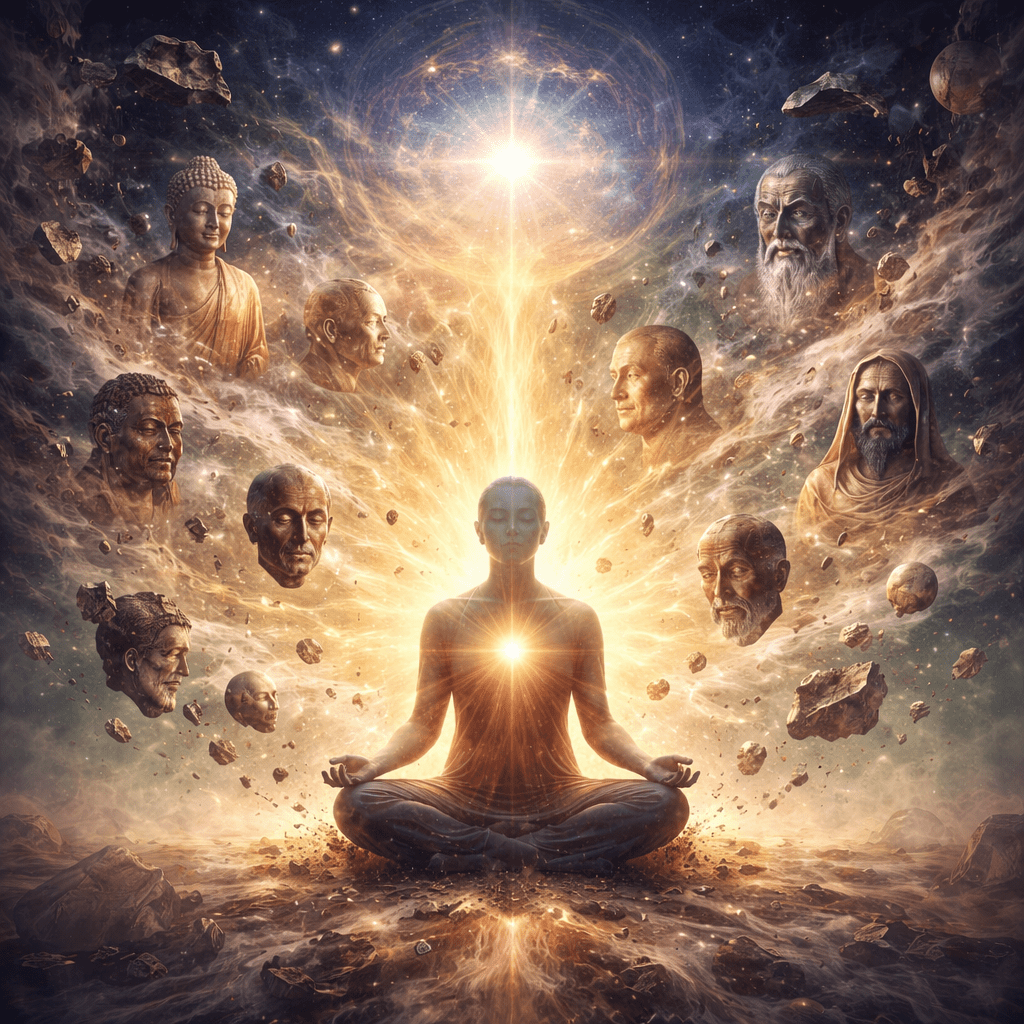
When Enlightenment Is Mistaken for Personality
History remembers spiritual figures as icons, not as enigmas. Reverence crystallizes their lives into models to be copied rather than mysteries to be understood. Over time, enlightenment becomes entangled with biography. Traits that belonged to a particular body–mind are elevated into universal prescriptions.
Such confusion gives rise to a subtle distortion. One person’s temperament becomes another’s discipline. A preference becomes a vow. A condition becomes a doctrine. Devotees inherit fragments of behavior and assume they are inheriting truth itself. Institutions form around this misunderstanding, reinforcing the illusion that realization can be standardized.
Consider how easily abstinence, dietary habits, or psychological dispositions are mistaken for signs of awakening. An enlightened being may express through a quiet demeanor or intense rigor, yet neither silence nor intensity constitutes realization. Personality remains a vessel. Enlightenment is not defined by what that vessel contains.
Questions deepen when examining what might be labeled today as mental disorder or neurological variance. Practices born from clarity may appear indistinguishable from compulsions when observed through the lens of clinical interpretation. Conversely, compulsions may be sanctified when clothed in sacred language. The boundary between pathology and transcendence becomes blurred by interpretation rather than direct insight.
Playing the skeptic reveals a paradox. Spiritual traditions may preserve genuine transmissions of truth while simultaneously embedding cultural assumptions and psychological projections. Followers then chase appearances rather than essence, mistaking echoes for origin. Rituals multiply. Dogmas ossify. Authentic realization becomes obscured beneath layers of imitation.
Direct experience dismantles this confusion. Recognition dawns that enlightenment does not conform to behavioral templates or moral archetypes. Awareness reveals itself as the ground of all appearances, untouched by characteristics attributed to the enlightened individual. Personal expression arises from conditioning, biology, context, and circumstance. Realization neither requires nor rejects these variables.
A moment of true seeing dissolves the need to emulate. What once seemed external becomes unmistakably intimate. Every form, thought, sensation, and condition reveals itself as inseparable from the same boundless essence. Even the impulse to categorize enlightenment as virtue or disorder dissolves into a wider recognition.
Existence itself appears as a dynamic expression of a single indivisible presence. Labels fade. Distinctions soften. What remains is a knowing beyond concepts, untouched by cultural framing or psychological interpretation. Enlightenment ceases to be an achievement or identity. It becomes the simple recognition of what has always been.
Such recognition liberates the seeker from imitation. Spiritual maturity unfolds not through copying another’s life but through discovering the source from which all lives arise. When this is seen, the notion of following a template loses relevance. Only clarity remains, revealing that every expression, sacred or mundane, emerges from the same unbounded reality.
Morgan O. Smith
 Morgan O. Smith