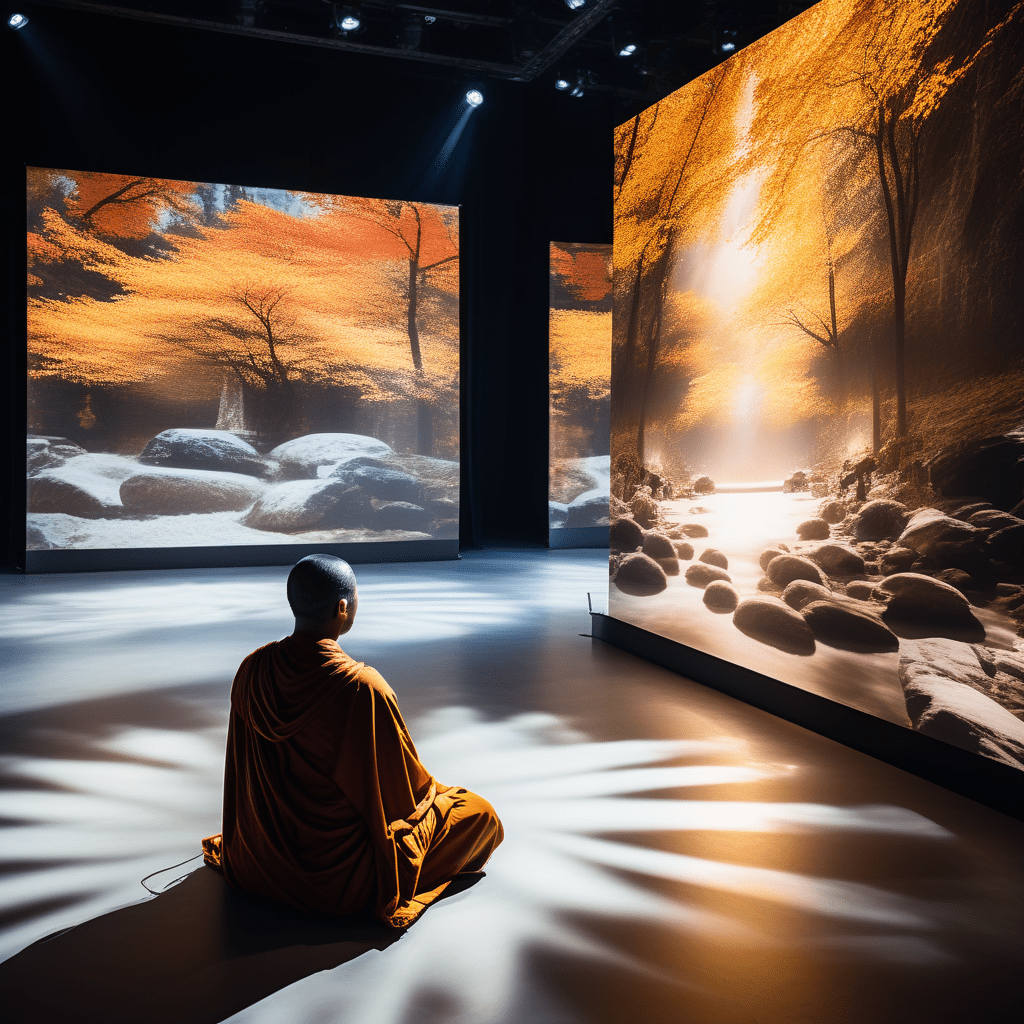
A Journey Beyond Words
The quest for spiritual enlightenment is a journey that transcends mere words and enters the realm of profound inner transformation. In the West, enlightenment is often equated with a comprehensive understanding of one’s true nature. This interpretation focuses on the illumination of the self, its intricacies, and its connection to the larger universe. It’s a state of comprehension, where the veils of ignorance are lifted, revealing the true essence of being.
In Eastern traditions, particularly Buddhism and Advaita Vedanta, enlightenment takes on a different hue. Here, it’s synonymous with Nirvana or Moksha – the liberation from the endless cycle of birth, death, and rebirth, known as samsara. This liberation is not just an intellectual understanding but a profound realization that leads to the dissolution of the self. In Buddhism, this is conceptualized as Anatta or no-self, a realization that the self is an illusion and liberation lies in transcending it.

Similarly, in Hinduism, Moksha aligns with the concept of Brahman – the ultimate reality or universal self. While seemingly different, both Nirvana and Moksha converge on the same endpoint: liberation from all forms of suffering and the cycle of samsara.
However, there’s a subtle yet significant distinction to be made. One can achieve spiritual enlightenment – a deep comprehension of their nature and the nature of reality – yet still be bound by the chains of samsara. It’s a state of awakening, an important step on the path, but not the culmination. True liberation, as seen in the concepts of Nirvana and Moksha, involves not just comprehension but also a complete surrendering of the self, a realization of its illusory nature, and ultimately, liberation from the cycle of existence.

Thus, while spiritual enlightenment and Nirvana (or Moksha) are often used interchangeably, their meanings diverge significantly based on cultural and philosophical contexts. In the West, enlightenment is primarily about understanding, while in Eastern philosophies, it’s about liberation. Only when the facets of comprehension, surrendering, realization, and liberation are all present can we step beyond spiritual awakening into the realm of true spiritual enlightenment.
Morgan O. Smith
Yinnergy Meditation, Spiritual Life Coaching & My Book, Bodhi in the Brain…Available Now!
 Morgan O. Smith
Powerful read. Being born and raised a Westerner, the journey to find one’s self, is extremely self based. While reading, simotaneously, comparing the Western and Eastern philosophies of both, there is a point of profound reflection. Westerners quest for the realization of self, enlightenment is an awakening to sustain life itself and to push back the physical death through the highest form of self mastery, a checkmate of the spiritual, mental and physical. From my own experience, the process in the Western world, is the supreme insatiable quest for enlightenment to conquer death, the ego plays a major part it this longing. For most Westerners silencing the mind is a lifelong challenge, as thoughts of the past and future keep the mind without rest. The unyielding need to ALWAYS be in though, keeps the complete detachment from self, the greatest battle to no-self.
LikeLiked by 1 person
🙂
LikeLiked by 1 person