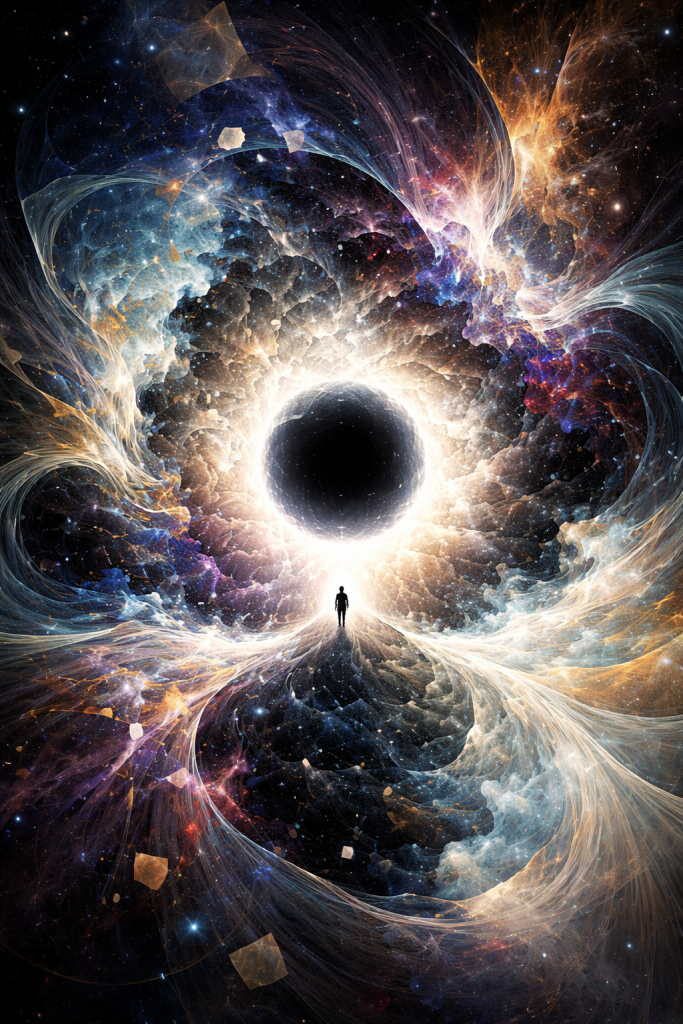
You are the void surrounded by your own self as substance, brought forth by its own thinking, shaped by its own thoughts.
Not as symbolism. Not as spiritual ornamentation. Simply as a description of what is already occurring before interpretation.
Substance feels dense because thought lingers. Thinking slows openness into shape, then convinces itself the shape possesses independence. Solidity is an effect of attention held too tightly. The void does not interfere. Allowance is enough for appearance to unfold.
Creation does not originate with matter. A quieter shift precedes it—the faint suggestion of separation. Something entertains the idea of being something rather than everything. That subtle narrowing gives rise to form, continuity, memory, and the felt position of a self observing from somewhere.
The void is not just empty. Emptiness would imply absence. What exists here is freedom from insistence. No preference. No correction. When thought moves, substance organizes. When thought loosens, substance reveals its temporary nature.
Identity feels heavy because repetition gives it mass. Familiar thoughts replayed long enough acquire gravity. The mind labels this accumulation “me.” The void registers movement, nothing more.
Nothing requires removal. Nothing asks to be fixed. Recognition alone softens what once appeared solid. Structure relaxes into responsiveness. Boundaries become functional rather than absolute.
Silence does not depend on quiet. Silence appears when thought releases its claim to authorship. Experience continues, but no longer points back to a controller or witness standing apart.
The void never hides behind form. Form arises within it and borrows its apparent stability from sustained attention. When attention eases, what remains cannot be framed as presence or absence. Language fails because nothing is missing and nothing needs to appear.
No final claim can be made. No definition holds without collapsing into another. What happens does so without explanation. What appears does not require justification. Everything stands exactly as it is.
Nothing here can be stated as what it is or what it is not. Nothing explains how this occurs. Perspectives arise according to position, history, and capacity, each contributing its angle without canceling another. No single view completes the picture. Together, they form what cannot be reduced to parts.
Truth does not belong to one standpoint. Wholeness expresses itself through difference, not despite it.
Morgan O. Smith
Get Your Free Copy of My Book, Bodhi in the Brain!
 Morgan O. Smith