Everything Is Ultimate Truth

Everything Is Ultimate Truth Appearing as Truth and Falsehood

A paradox sits quietly at the heart of perception. What is taken to be true, what is dismissed as false, both arise within the same indivisible field. Judgments feel solid, yet their certainty depends on shifting frames of reference. Change the angle, and what once seemed unquestionable dissolves into ambiguity.

Truth, as commonly held, leans on agreement, evidence, coherence. Falsehood stands as its opposite, rejected, corrected, or exposed. Yet both require awareness to be known. Without awareness, neither truth nor falsehood can appear. That simple recognition begins to unravel the hierarchy placed between them.

Consider how a dream operates. While immersed, every image carries a sense of reality. Only upon waking does the distinction emerge. The dream was not meaningless; it expressed something real, yet not in the way it first appeared. Daily life mirrors this pattern more than most are willing to admit. Convictions harden, identities form, narratives repeat, all while resting upon an unexamined ground.

Ultimate Truth does not compete with relative truths. It does not correct them, nor does it validate them. It allows them. Every belief, every illusion, every clarity, every confusion unfolds within it without preference. That which is mistaken is not outside of truth; it is truth misperceived, truth wearing a mask, truth folding in on itself to create contrast.

Falsehood gains its power from partial seeing. Something is noticed, something else is ignored, and a conclusion is drawn. The conclusion may serve a purpose, yet it remains incomplete. What is called false often reveals itself as a fragment of a larger whole, misunderstood due to limitation rather than absence.

This shifts the inquiry. Instead of asking what is true or false, attention turns toward the nature of the one who makes that distinction. Who or what is aware of both? What remains unchanged whether the mind lands on certainty or doubt?

A deeper stability begins to emerge. Truth is no longer a position to defend. Falsehood is no longer an enemy to eliminate. Both are movements within a boundless presence that does not fracture under contradiction. Clarity does not come from choosing one side, but from seeing the space in which both arise.

Conflict softens when this is seen. Arguments lose their edge, not because differences disappear, but because their foundation is understood. Each perspective becomes a temporary expression, shaped by conditions, history, perception. None stand alone, none define the whole.

Ultimate Truth remains untouched by the play of appearances. Yet it expresses itself through that very play. Every mistake, every insight, every contradiction becomes part of its unfolding. Nothing falls outside of it, not even the denial of it.

Recognition does not require abandoning discernment. Practical distinctions still function. Fire burns, water cools, words carry consequences. Life continues to operate within relative frameworks. What changes is the weight assigned to them. Certainty loosens. Flexibility deepens. Openness expands.

What was once divided begins to reveal its unity. Truth and falsehood no longer stand as opposing forces, but as complementary expressions arising from a single source. That source cannot be captured by either, yet both depend on it entirely.

Silence often communicates this more clearly than thought. Not the absence of sound, but the absence of fixation. A resting that allows everything to be as it is, without the need to resolve the paradox.

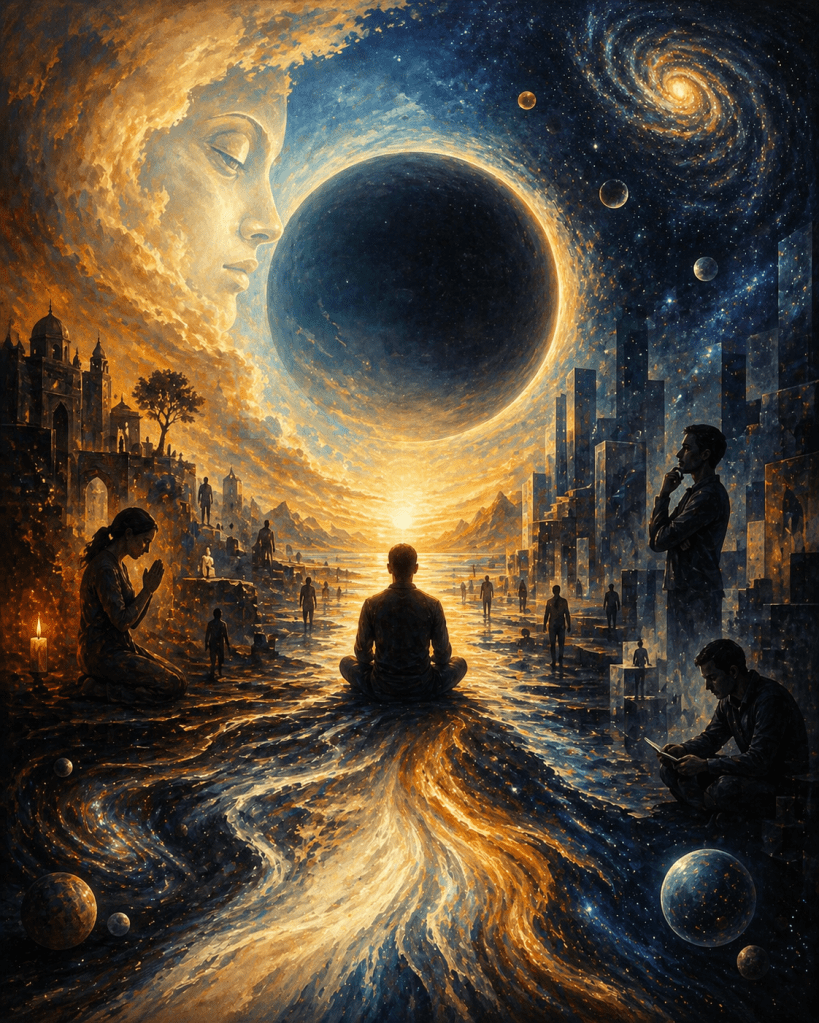
Everything is Ultimate Truth, not because everything is correct, but because everything appears within what cannot be divided. Even the illusion of separation is included. Even the belief in falsehood is held within what never ceases to be whole.

Morgan O. Smith

Today’s the Day!

BODHI IN THE BRAIN Begins This Evening

Hello everyone,

Today’s the day.

If you’re living in Canada in the Toronto area, we’d love to have you join us.

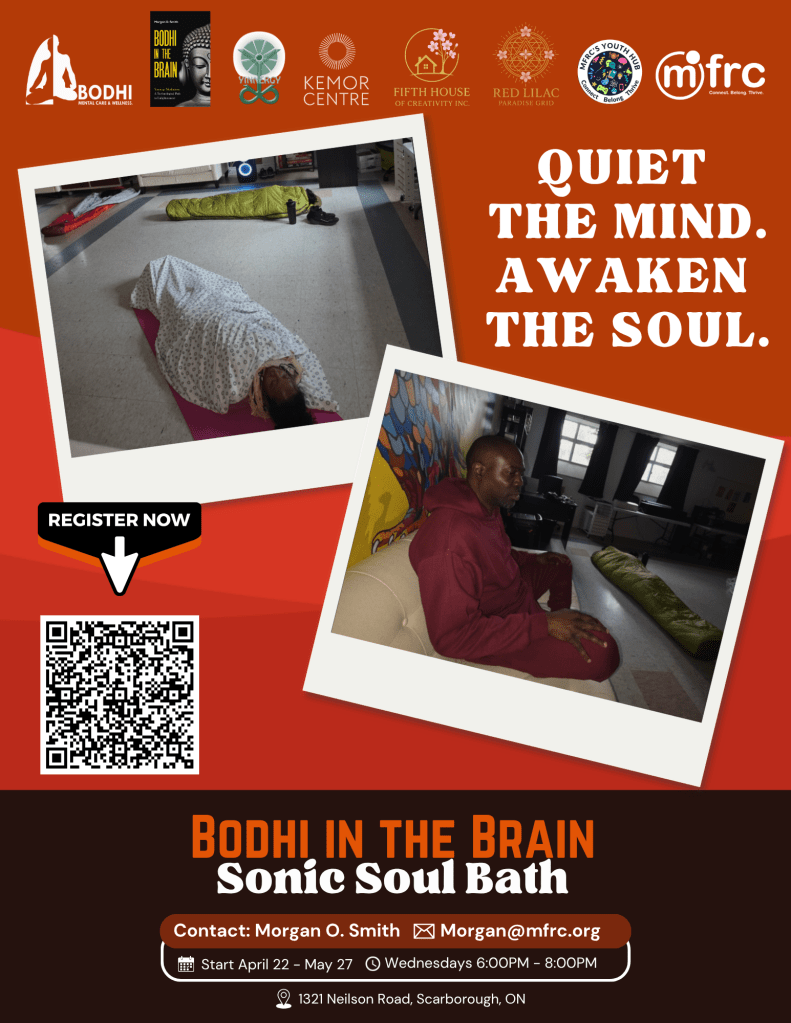
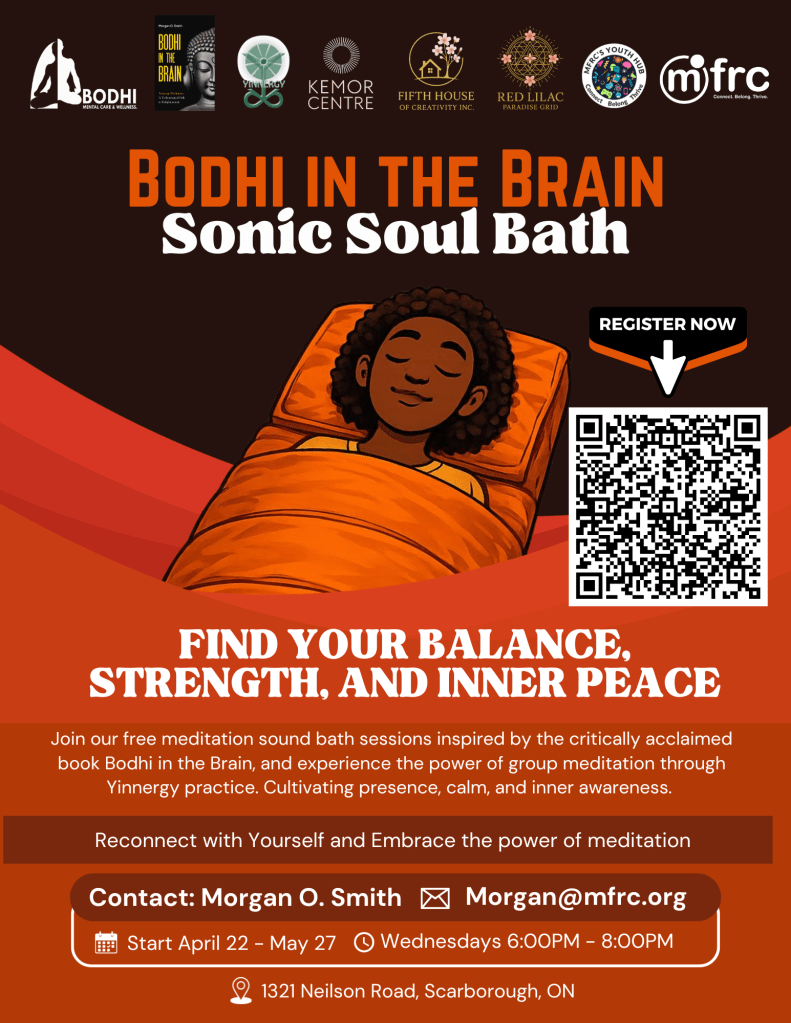
We begin our 6-week BODHI IN THE BRAIN — Sonic Soul Bath series this evening, and I’m looking forward to sharing this experience with you.

Join us for a deeply restful and immersive session featuring booming contemporary R&B blends, rich 808 bass, and brainwave entrainment designed to gently guide your state from beta to alpha, theta, and into delta.

Bring your sleeping bag or yoga mat, along with a pillow for comfort, and allow yourself the space to fully unwind. Whether you’re coming after a long day of work, studying, or caring for the family, this is a chance to settle in, let go, and go deeper together in one shared space.

Free admission. Light snacks will be provided.

BODHI IN THE BRAIN — Sonic Soul Bath
Every Wednesday from April 22 to May 27
6:00 PM to 8:00 PM
1321 Neilson Road, Scarborough, ON

Contact: Morgan O. Smith
morgan@mfrc.org

See you all later this evening.

Morgan

Ceasing to Exist Is Existence

What feels like disappearance is often the unveiling of what never arrived and never left.

Identity clings to continuity. It insists on narrative, on form, on something stable enough to say, “this is me.” Yet every sincere glimpse beneath that surface reveals something unsettling; there is no fixed centre holding it all together. Thoughts pass. Sensations dissolve. Emotions rise and vanish without permission. Even the sense of being a “someone” flickers in and out of awareness.

So what exactly is ceasing?

What we call existence is usually filtered through attachment to form. Body, memory, personality, history; these become the reference points for being. When any of these begin to loosen, a quiet panic can emerge. It feels like loss. It feels like the edge of annihilation. Something in us resists, because it interprets the fading of form as the fading of existence itself.

But that interpretation is flawed.

Ceasing does not touch existence. It only dismantles the illusion of containment.

Consider the moment between two thoughts. There is no identity there, no story, no personal reference point. Yet something undeniable remains. Awareness does not collapse in that gap. It stands unobstructed, without needing to announce itself. That silent interval is not absence; it is presence without definition.

The fear of ceasing arises from confusion between what appears and what is. Appearances come and go. They are meant to. Existence, however, does not operate within that cycle. It is not born when a form emerges, nor does it die when a form dissolves. It simply is, untouched by the movement it allows.

Letting go, then, is not an act of surrendering existence. It is the recognition that existence was never dependent on what you thought you were.

This is why deep realization can feel like a kind of death. The structures that once provided orientation fall away. The familiar reference points dissolve. Even the sense of being the experiencer can collapse. Yet what remains is not void in the way the mind imagines. It is fullness without boundary. Presence without identity. Being without ownership.

Ceasing reveals that nothing real was ever at risk.

Every moment already contains this truth. Each ending—of a breath, a thought, a sensation, is a quiet demonstration. Something ends, yet nothing essential is diminished. Life continues, but not as a personal possession. It unfolds as an expression of something indivisible.

Existence does not belong to you.

You belong to existence only as an appearance within it.

When this becomes clear, the resistance softens. The need to preserve a fixed self begins to lose its urgency. Ceasing is no longer feared. It is understood as a return; not to something new, but to what has always been prior to every assumption of “I am this.”

Existence does not require you to remain.

It reveals itself most clearly when you don’t.

Morgan O. Smith

Awaken your inner world with Yinnergy

Ready to release emotional heaviness, find more clarity, and deepen your meditation practice? Yinnergy’s guided sound-based meditation experience is designed to help you go inward, reset, and reconnect.

🌿 Supports emotional balance
🧠 Encourages mental clarity
💫 Deepens self-awareness and inner transformation
🎧 Easy to use with headphones from home

Whether you’re new to meditation or ready for a deeper journey, Yinnergy offers a powerful path to inner growth.

BODHI IN THE BRAIN – Sonic Soul Bath

Step out of the noise and into something deeper.

This is more than meditation.
This is a guided return to your natural state—where clarity, strength, and stillness arise without force.

Through Yinnergy-based sound immersion, you’ll experience a space where the mind softens, the body releases, and awareness becomes effortless.

No pressure. No performance. Just presence.

✨ Free group sessions
✨ Designed for real inner shifts
✨ Open to all levels

Come as you are. Leave more aligned than you arrived.

📅 April 22 – May 27
🕕 Wednesdays | 6PM – 8PM
📍 1321 Neilson Road, Scarborough

Scan the QR code to register.

Crucified Between Division

Awareness, Ego Death, and the Union of Mind and Emotion

A statement spoken in the midst of suffering reveals more than compassion; it unveils a profound diagnosis of human consciousness. “Father forgive them, for they don’t know what they do” points not toward moral failure, but toward a blindness so complete that action unfolds without true seeing.

Lack of awareness is not merely ignorance of facts; it is a fragmentation of perception. Thought moves in one direction, emotion in another, and the deeper currents of being remain unrecognized. Life becomes mechanical, reactive, conditioned. From that state, harm arises; not out of intention alone, but from disconnection within oneself.

Meditation introduces a different possibility. Rather than adding knowledge, it begins to dissolve the divisions that create confusion. The mind quiets, the emotional field settles, and something more integrated begins to emerge. What was previously split starts to communicate.

Viewed through a tantric lens, this integration takes on symbolic depth. The left hemisphere reflects structured thought, analysis, the architecture of concepts. The right hemisphere reflects intuition, feeling, the subtle currents that cannot be reduced to language. Most people live tilted; identified more with one than the other, rarely aware of the imbalance.

When these two aspects come into harmony, perception shifts. Thought no longer suppresses feeling, and feeling no longer clouds thought. A unified intelligence begins to function—clear, direct, and undivided. This is not intellectual brilliance or emotional intensity alone, but a deeper coherence of being.

The imagery of crucifixion can be read beyond history and theology. Suspended between two thieves, a central figure undergoes total surrender. The thieves, in this interpretation, can be seen as the divided faculties; mind and emotion, each incomplete on its own. The centre represents the point where both are witnessed, transcended, and ultimately brought into alignment.

Ego, in this sense, is not destroyed violently but revealed as insufficient. Its grip loosens when awareness expands beyond the fragments it tries to control. What remains is not emptiness in the negative sense, but a clarity that no longer depends on division.

Forgiveness then becomes natural, not forced. When one truly sees that actions arise from unconscious fragmentation, blame loses its foundation. Compassion emerges, not as a virtue to practice, but as the inevitable response of a mind that is no longer divided against itself.

Awareness is not something added to the individual; it is what remains when fragmentation dissolves. When both hemispheres function in coherence, perception is no longer split between thinker and feeler, observer and participant. There is simply knowing, without distortion.

Perhaps the deeper message is not about what was done, but about what was not seen. And through that recognition, a different way of being becomes possible; one where action arises from wholeness rather than division.

Morgan O. Smith

The Shadow of the Absolute

Absolute reality is often imagined as pristine, untouched by fracture or contradiction. Spiritual language tends to elevate the ground of all being into something luminous, serene, and eternally harmonious. Yet such portrayals can become subtle distortions, projecting human preferences onto what cannot be reduced to preference at all.

A paradox emerges the moment one considers totality without exception. That which includes everything cannot exclude darkness. Absolute wholeness does not merely contain light; it also contains the conditions for obscurity, confusion, and dissolution. Darkness is not an error within the whole but a necessary expression of completeness.

Perception recoils from this idea because it challenges the instinct to divide existence into sacred and profane. Thought longs for a purified origin, a source untouched by contradiction. Reality, however, refuses such simplification. A ground that generates multiplicity must also generate polarity. Shadow is not a flaw in the absolute; shadow is the evidence that nothing has been left out.

Mystical insight sometimes reveals a luminous unity, a direct recognition that all forms arise from a single boundless presence. Such experiences carry a sense of purity and peace. Yet stabilization of that recognition requires a deeper maturity: the willingness to acknowledge that the same boundlessness also births terror, ignorance, and fragmentation.

Resistance to this insight often leads to spiritual bypassing. Individuals cling to transcendence while denying the darker textures of existence. Absolute realization does not erase complexity. Genuine awakening expands capacity to embrace the full spectrum of being without retreating into selective idealization.

A universe that manifests stars also manifests collapse. Consciousness that illuminates truth also generates illusion. Absolute reality stands prior to judgment, neither endorsing nor rejecting the movements arising within it. Shadow becomes a teacher rather than an adversary once this is understood.

Human life mirrors this cosmic structure. Personal development frequently involves confronting suppressed aspects of identity. Integration replaces avoidance. Clarity emerges through engagement rather than denial. Recognition of one’s own shadow deepens reverence for the vast intelligence that allows contradiction to coexist.

Absolute reality remains unbroken even while appearing fragmented. Darkness does not diminish the ground of being; it reveals its radical inclusivity. True spiritual maturity rests upon this recognition: wholeness requires nothing less than everything.

Morgan O. Smith

Beyond Imitation

When Enlightenment Is Mistaken for Personality

History remembers spiritual figures as icons, not as enigmas. Reverence crystallizes their lives into models to be copied rather than mysteries to be understood. Over time, enlightenment becomes entangled with biography. Traits that belonged to a particular body–mind are elevated into universal prescriptions.

Such confusion gives rise to a subtle distortion. One person’s temperament becomes another’s discipline. A preference becomes a vow. A condition becomes a doctrine. Devotees inherit fragments of behavior and assume they are inheriting truth itself. Institutions form around this misunderstanding, reinforcing the illusion that realization can be standardized.

Consider how easily abstinence, dietary habits, or psychological dispositions are mistaken for signs of awakening. An enlightened being may express through a quiet demeanor or intense rigor, yet neither silence nor intensity constitutes realization. Personality remains a vessel. Enlightenment is not defined by what that vessel contains.

Questions deepen when examining what might be labeled today as mental disorder or neurological variance. Practices born from clarity may appear indistinguishable from compulsions when observed through the lens of clinical interpretation. Conversely, compulsions may be sanctified when clothed in sacred language. The boundary between pathology and transcendence becomes blurred by interpretation rather than direct insight.

Playing the skeptic reveals a paradox. Spiritual traditions may preserve genuine transmissions of truth while simultaneously embedding cultural assumptions and psychological projections. Followers then chase appearances rather than essence, mistaking echoes for origin. Rituals multiply. Dogmas ossify. Authentic realization becomes obscured beneath layers of imitation.

Direct experience dismantles this confusion. Recognition dawns that enlightenment does not conform to behavioral templates or moral archetypes. Awareness reveals itself as the ground of all appearances, untouched by characteristics attributed to the enlightened individual. Personal expression arises from conditioning, biology, context, and circumstance. Realization neither requires nor rejects these variables.

A moment of true seeing dissolves the need to emulate. What once seemed external becomes unmistakably intimate. Every form, thought, sensation, and condition reveals itself as inseparable from the same boundless essence. Even the impulse to categorize enlightenment as virtue or disorder dissolves into a wider recognition.

Existence itself appears as a dynamic expression of a single indivisible presence. Labels fade. Distinctions soften. What remains is a knowing beyond concepts, untouched by cultural framing or psychological interpretation. Enlightenment ceases to be an achievement or identity. It becomes the simple recognition of what has always been.

Such recognition liberates the seeker from imitation. Spiritual maturity unfolds not through copying another’s life but through discovering the source from which all lives arise. When this is seen, the notion of following a template loses relevance. Only clarity remains, revealing that every expression, sacred or mundane, emerges from the same unbounded reality.

Morgan O. Smith

Freedom Within Identification

Attempts to dismantle identification often become another subtle strategy of identification. The effort itself reinforces the one who is trying to escape. What actually transforms experience is not the reduction of bias or judgment, but clear recognition that bias and judgment are occurring. Awareness does not erase the movement of mind; awareness reveals it.

Mind evaluates. Mind categorizes. Mind reacts. Such functions belong to its design. A deeper dimension remains untouched by those operations. That dimension does not oppose the mind, nor attempt to purify it. Silent witnessing simply illuminates what unfolds.

Moments of awakening sometimes arrive with overwhelming clarity. Identification dissolves, yet experience continues. No boundary remains between observer and observed, yet perception still functions. Such glimpses demonstrate a truth that later integrates into lived reality. Peak illumination offers insight; maturation transforms insight into stability.

Gradual integration reshapes the relationship with identity. Layers fall away without force, guided by ongoing recognition. Ego continues its role as a generator of form, narrative, and orientation. Awareness does not eliminate ego; awareness contextualizes it. Form becomes expression rather than prison.

Attachment has long been described as the seed of suffering. Another dimension exists within that same principle. Attachment also creates continuity, warmth, belonging, and coherence. Pleasure and pain arise from the same ground. Human experience oscillates across a spectrum that includes both. Heaven and hell manifest through perception, circumstance, and interpretation, rather than distant metaphysical destinations.

Escape from the spectrum intensifies struggle. Unconscious immersion perpetuates distress. Acceptance introduces a different movement: a willingness to meet existence as it appears. Acceptance does not romanticize suffering, nor cling to comfort. Acceptance recognizes the inevitability of cycles.

Samsara refers not only to rebirth across lifetimes. Samsara unfolds through biological rhythms, emotional tides, cultural dynamics, social realities, and economic fluctuations. Each domain participates in patterns of emergence, dissolution, and renewal. Cells regenerate. Identities evolve. Conditions transform.

Total liberation from these cycles cannot occur while embodiment persists. Yet insight can reveal a dimension untouched by cyclical change. Awakening discloses a freedom that coexists with limitation. Temporary realization becomes the doorway to enduring equanimity.

Pain, pleasure, loss, gain, exhaustion, vitality—each appears as modulation within a larger field of being. Recognition of that field softens resistance. Suffering loses its compulsive urgency. Beauty becomes perceptible even through difficulty.

Freedom does not require the absence of attachment. Freedom emerges through understanding that attachment never defined the essence of what one is. Identity remains operational, yet no longer absolute. Life continues with all its contrasts, while awareness rests as the unbound ground of experience.

Morgan O. Smith

When Everything Feels Raw

Sensitivity often increases when perception begins to clear.

Sounds feel sharper. Emotions carry more weight. Light appears brighter. Even small interactions can land with surprising intensity. What once passed unnoticed now registers deeply, almost as if the protective filters of the mind have thinned.

Everything feels raw.

This rawness can be confusing. Many assume spiritual growth should produce constant calm or detachment. Instead, greater awareness frequently exposes what has always been present but hidden beneath distraction and conditioning.

Life becomes vivid.

Rawness does not necessarily mean fragility. It often signals openness. The nervous system is no longer numbed by habit. Experience is received directly rather than buffered through layers of interpretation.

Pleasure becomes clearer.

Pain becomes clearer as well.

Each moment arrives without as much resistance. Joy may appear unexpectedly in simple things—breathing, walking, sunlight touching the skin. At the same time, sorrow or discomfort may feel closer to the surface. The range of experience expands rather than contracts.

Many people try to escape this stage.

They attempt to rebuild the old armor. They seek ways to dull sensation again. Yet the invitation within rawness is not to retreat. It is to learn how to remain present without shutting down.

Strength develops differently here.

Instead of emotional walls, stability comes from grounding. Slow breathing. Physical movement. Honest conversation. Quiet time without stimulation. These simple actions help the nervous system integrate heightened sensitivity.

Raw perception eventually refines into clarity.

At first, awareness may feel overwhelming, like standing in bright sunlight after leaving a dark room. Gradually the eyes adjust. What once seemed too intense becomes natural. The system learns to hold experience without being consumed by it.

Rawness becomes intelligence.

The heart responds more quickly to suffering. Compassion becomes immediate rather than theoretical. The body senses subtle shifts in energy and emotion. Boundaries become clearer because sensitivity recognizes what nourishes and what drains.

Nothing is filtered unnecessarily.

Life arrives unedited.

This does not mean living in constant vulnerability. It means allowing experience to move through awareness without the reflex to numb it. Over time the sharp edges soften. What remains is a steady presence capable of feeling deeply without collapsing.

Rawness is often the early stage of authenticity.

The layers of performance and protection loosen. What remains may feel exposed, but it is also real. Beneath that exposure lies a quiet strength that no longer depends on pretending to be unaffected.

Everything feels raw because awareness is finally touching life directly.

And direct contact, though intense, is also profoundly alive.

Morgan O. Smith