A Journey Towards Self-Realization
Introduction:
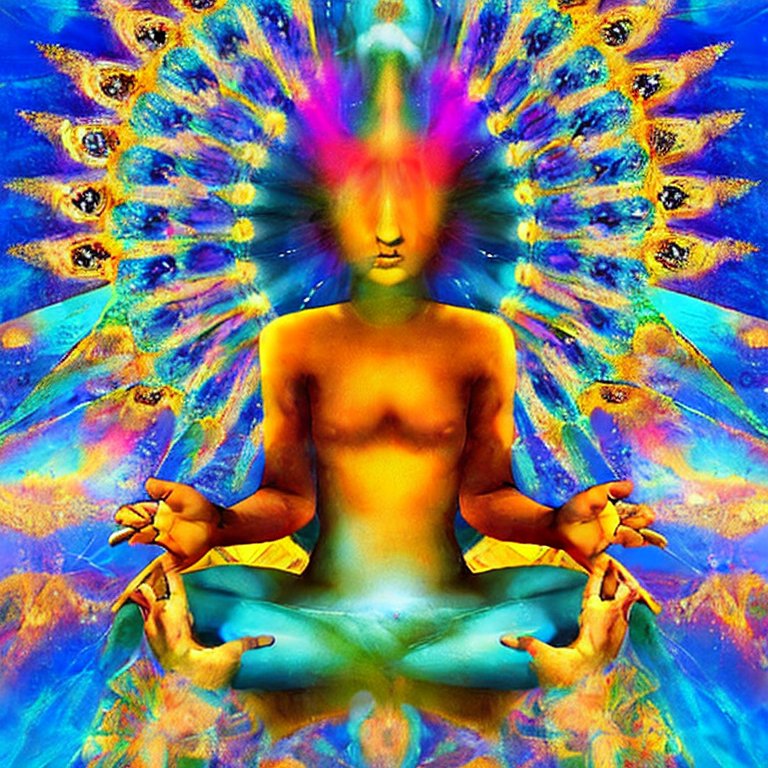
Meditative practices have long been revered as transformative tools in the realm of self-discovery and spiritual growth. They offer a profound pathway for individuals to explore the depths of their consciousness, seeking truth, peace, and liberation. However, beneath the surface lies a fascinating paradox—the false self, which appears as the practitioner, ultimately leads to the revelation of the Ultimate Self, the Ground of All Being.
The Illusion of the False Self:
Within the tapestry of various spiritual traditions, the notion of the false self arises—a deceptive construct born out of our attachments to external roles, labels, and conditioned beliefs. This illusory identity emerges from our tendency to assign significance to transient aspects of our existence, such as social standing, material possessions, and superficial identities. Meditative practices, in their diverse forms, serve as illuminating mirrors, enabling us to perceive the transient nature of the false self and transcend its illusory grasp.
Meditation as a Mirror:
Meditation acts as a reflective surface, offering a clear reflection of the illusory nature of the false self. By turning inward and observing our thoughts, emotions, and sensations without judgment or attachment, we gain a heightened awareness of the ever-changing nature of our experiences. Regular practice nurtures a profound realization—an understanding that our thoughts come and go, emotions rise and subside, and identities shift fluidly. This awakening brings us closer to recognizing that the false self is not a fixed entity but a construct that can be deconstructed through the power of self-inquiry.
The Ultimate Self:
While meditative practices may originate from the false self, they hold within them the potential to reveal the Ultimate Self—the very essence of our being, the Ground of All Being. As we delve deeper into our meditative journey, we begin to touch upon an interconnectedness and unity with the vast cosmos. The boundaries that once separated our individual selves from the external world begin to dissolve, and we catch glimpses of the inherent oneness that permeates all existence. In this expanded state of awareness, the false self loses its grip, and we realize that our essential nature transcends the limitations of individual identity.
Integration and Transformation:
The true essence of meditative practices lies in the interplay between the false self and the Ultimate Self. The false self, while illusory, acts as a vehicle for the exploration and transformation of consciousness. Engaging with meditative practices allows us to intimately observe the patterns and tendencies of the false self, ultimately leading us to transcend its limitations. By embracing the false self as a catalyst for growth, we integrate its lessons and move closer to the realization of our true nature—the Ultimate Self.
Conclusion:
In the realm of meditative practices, the interconnection between the false self and the Ultimate Self invites profound contemplation. While the false self may present itself as real and compelling, it is merely a construct that can be unravelled through the transformative power of meditation. Engaging in these practices propels us on a journey of self-realization, unveiling the essence of our being—the Ground of All Being. Meditative practices serve as bridges, guiding us from the illusion of the false self to the profound truth of our interconnected existence. Embrace these practices, embrace the false self, and embark on the path toward ultimate liberation and self-realization.
Morgan O. Smith
Yinnergy Meditation & My Book, Bodhi in the Brain…Available Now!
https://linktr.ee/morganosmith


 Morgan O. Smith